


A "Groundbreaking" CPA Rehabilitation - Louisa May Alcott's Orchard House in Concord
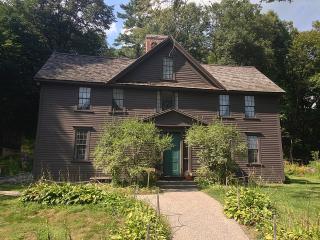
Written by Katherine Roth Huse
Editor's Note: In 2022, Katherine Roth Huse had the opportunity to tour the Orchard House in Concord, MA after the town utilized CPA funding to rehabilitate the historic landmark with a cutting-edge geothermal heating system. In this special CPA Success Story feature, Katherine recounts the fascinating history of the former home of Louisa May Alcott, as well the local CPA collaborations that allowed Concord to preserve this unique historic asset. Katherine Roth Huse formerly served as the Associate Director of the Community Preservation Coalition until 2016—today, she lends her extensive experience with the CPA program as an at-large member of the Coalition’s Steering Committee.
In 1870, Louisa May Alcott installed the first whole-house heating system in Orchard House, her family’s c. 1690 Concord home. State-of-the art for its day, it was a coal furnace with ductwork, some of which is still visible to visitors touring the rooms of the house today.
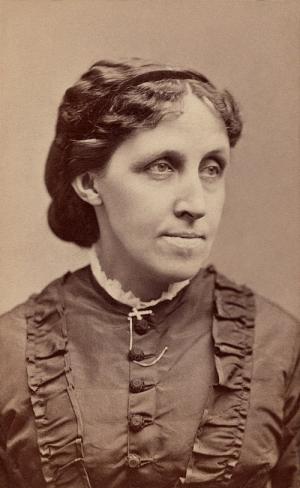 Alcott, of course, is the beloved American author best known for her semi-autobiographical book Little Women. It has been translated into at least 50 languages, has never been out of print, and as late as 2014, Little Women was named one of Americans’ 100 all-time favorite books.1 Orchard House was where Alcott penned Little Women, and it served as Alcott’s setting for the book - and since 1912, it has operated as a historic museum open to the public. The property is stewarded by the nonprofit Louisa May Alcott’s Orchard House, and according to their Executive Director Jan Turnquist, the museum receives at least 50,000 visitors per year, the highest attendance across all the indoor historic sites in Concord. Visitors to the museum, including many international tourists, learn about the Alcott family’s involvement with the Transcendentalist Movement, their friendship with important contemporary local thinkers like Ralph Waldo Emerson and Henry David Thoreau, their support for the Underground Railway and other progressive movements, and Louisa May Alcott’s unique-for-its-day primary breadwinner role for her family, which she kept afloat financially with her writing.
Over the years, Orchard House’s initial heating system installed by Alcott received a number of overhauls, explains Jay Powers, the property’s longtime Facilities Manager. In 1996, the decision was made to keep Orchard House open to the public year-round, which added the challenge of maintaining the proper heat and cooling to allow for a comfortable staff and visitor experience 365 days a year. The house is filled with historic artifacts that require a constant humidity for their long-term preservation, as well. Heating and cooling contractors working on the house over the years faced myriad obstacles in designing and installing systems to achieve these ends.
Like other historic New England homes, Orchard House was built with walls made of plaster and lathe with no insulation, leaving it as drafty as a barn in the winter, explains Turnquist. It was comprised of a hodge-podge of additions, with the Alcotts and other early owners making many alterations to the home over the years. Because of its historic nature and the plaster and lathe construction, no significant structural alterations could be made to the interior, and the house could only be taken apart to make repairs with extreme care from the outside. Attempts were made to blow in insulation in the 1970s, when the house was opened up for other repairs, but water got in and then the insulation failed and attracted animals. By the early 2010s, Turnquist and the non-profit’s board overseeing the property were faced with another in a long line of failed HVAC systems. The most recent heating system, installed in 2001-2002, was a gas-fired system with hot water radiators. Installed improperly by the contractor, it didn’t provide enough heat to keep staff and visitors comfortable. There were leaky valves, requiring buckets to be set under them. And in order to keep humidity levels constant, AC units had to be run at the same time as the heat.
 The non-profit’s board turned to a company called Energy Smart Solutions for advice, and the decision was ultimately made to pursue funding for a geothermal heating system to be installed on the Orchard House property. Geothermal heat is a clean energy combined-heating-and-cooling system still in its infancy in this country, but poised for liftoff, according to a January 18, 2025 article by Inside Climate News.2 These systems use ground source heat pumps to draw heat from wells drilled underground, or from fields of pipes buried beneath the earth’s surface, where temperatures remain at a constant 54 degrees Fahrenheit year-round, despite the outdoor temperature. The systems are highly cost effective and efficient, as they tap into a free, clean resource underground, and have no emissions. The only barrier to their widespread adoption is the relatively high capital costs of installation, including the drilling of wells and laying of underground pipes. Like electric vehicles, their high efficiency and lower overall costs pay off over time, but initial higher costs, typically $19,000 for a typical residential heating/cooling system after tax incentives, can deter many.3
Enter Concord’s Community Preservation fund: the nonprofit Louisa May Alcott’s Orchard House applied to the town’s Community Preservation Committee for $100,000 of CPA funds towards a total project cost of $350,000 (leveraging $250,000 of funds raised by the nonprofit). The CPA funds were approved by Concord Town Meeting on April 26, 2017, and installation of the new geothermal heating system began soon after, eventually being completed in 2018.
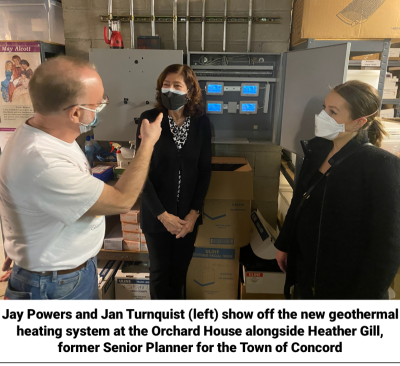 According to Turnquist and Powers, who have both spent their careers stewarding Orchard House (Turnquist since her 20s, and Powers since his teens), the geothermal heating system has been a huge success, and a win-win solution. Twelve wells were dug for the system, allowing for eight to power Orchard House, and four to power the nearby Concord School of Philosophy. This school is housed in a barn-like structure in back of Orchard House, built in 1880 by Bronson Alcott, Louisa May Alcott’s father, as the first-in-the-country school exclusively for adult education. Since the wells are buried underground, they don’t mar the historic character of the property in any way. A tour of the basement of Orchard House in mid-winter with Powers revealed a gleaming row of pumps and associated high-tech monitoring equipment, allowing for easy supervision and control of the temperature and humidity for maximum comfort and preservation of priceless artifacts throughout the property. The equipment is run by electricity, but is highly efficient, allowing for a 60-70% reduction in the property’s electric bills since installation of the new system.4 As we toured the site, the pumps hummed along almost noiselessly, another benefit hugely appreciated by staff and visitors alike, as the previous gas-fired furnace combined with air conditioners had been extremely loud.
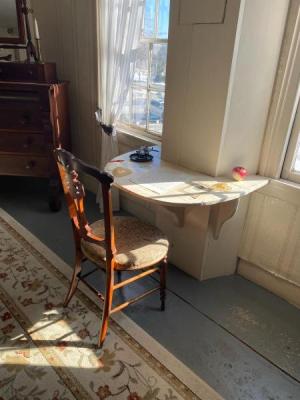 Later on, walking through the upper rooms of the house with Turnquist, we viewed the desk in the bedroom where Alcott sat and wrote her famous book, the temperature warm and comfortable even on a freezing February day. Likewise, a brief trip out back to the Concord School of Philosophy building demonstrated the ability of the new geothermal system to maintain a comfortable temperature even in an open barn-like structure.
For Turnquist and Powers, running the Orchard House property is more a vocation than a job, and their strong feelings about guarding and passing on the legacy of Louisa May Alcott and her remarkable family are evident. They are both thrilled that, thanks to the generosity of the Concord townspeople through their CPA fund, as well as other generous donors, they have been able to oversee the installation of a state-of-the-art heating and cooling system that responds to the climate emergency of our time. With no fossil fuels now burned on-site, the Alcott’s Orchard House is in the forefront of the town’s efforts to lower its overall carbon footprint and achieve its sustainability goals. The geothermal heating system at Orchard House has also inspired other communities to use the technology to heat, cool, and preserve their significant historic structures; the town of Arlington leaned heavily on Concord’s experience to fund and install a similar system at the historic Jason Russell House, an important Revolutionary War site in the center of that community, also using CPA funds.
Louisa May Alcott and her family were responsibly-minded people who were at the forefront of all the most progressive movements of their time, mused Turnquist at the end of our tour. Powers and Turnquist feel strongly that if the family knew about the climate emergency we currently face, they would have wanted to be at the forefront of efforts to respond to that emergency, too. Breaking ground – whether in thought, politics, economics, diet and health, literature, or the role of women in society – is what Louisa May Alcott and her family are perhaps best known for, and what they represented. Turnquist and Powers agree that in breaking ground with the installation of Concord’s first geothermal heating system, the nonprofit Louisa May Alcott’s Orchard House and the townspeople of Concord are keeping the Alcott’s important American legacy alive.
Notes
- George, Alice, Smithsonian Magazine, “Why Louisa May Alcott’s ‘Little Women’ Endures, September 18, 2018.
- McKenna, Phil, Inside Climate News, “A Little-Known Clean Energy Solution Could Soon Reach ‘Liftoff’”, January 18, 2025
- McKenna, Phil, Inside Climate News, “A Little-Known Clean Energy Solution Could Soon Reach ‘Liftoff’”, January 18, 2025
- Town of Concord, ‘Orchard House – Sustainability Case Study’, April 16, 2019, https://concordma.gov/documentcenter/view/19182